There is nothing I love more than being in a place I've never been, and I pretty much just want to go everywhere...
I can't get enough of travelling and sightseeing, so this blog is dedicated to the cool little places I would someday like to go.

Showing posts with label vacation. Show all posts

Sunday, April 21, 2013

“Ghost Town” : Bokod, Hungary

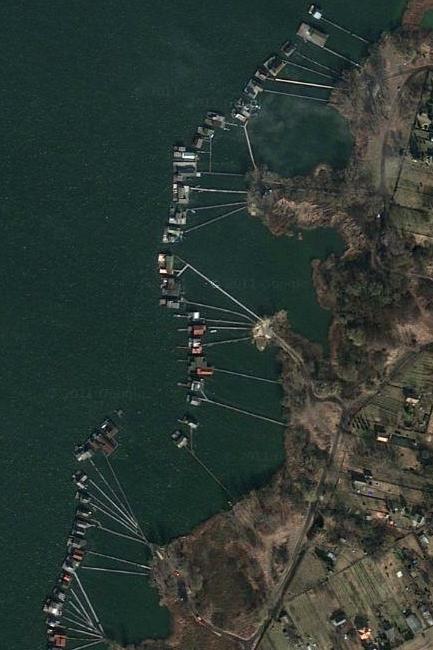
Bokod Hungary is not a tourist destination. It is barely visited – it’s just an old village on a lake. Along the lake shore, rickety boardwalks lead out over the lake to old fishing cottages that stand on stilts. It’s not the nicest location, but I think there’s something enchanting about the photographs, and there is certainly something artsy about the boardwalks and cottages on the misty water.

 
Bokod is a lake about 80 kilometers west of Budapest, the capital city of Hungary. It was hard to find information on Bokod. There was a website in Hungarian, but unfortunately I am not fluent in Hungarian, and google translate was not very helpful…
 
I’m not sure if the lake houses are inhabited – one website reported that they were abandoned but I’m not sure if it was a reliable source. If it is abandoned, I’m not sure if the boardwalks are even safe to walk on. I was disappointed when I realized this, because I saw the picture first and thought the lake houses seemed like a really cool place to stay.
 
Aeriel View
What to do? I probably wouldn’t actually visit Bokod, since there isn’t a lot to do there – just look at the houses and take some photographs I think. If I did, it would be part of a larger trip to Budapest. There are all kinds of things to do an sights to see in Budapest that would make for an excellent trip. I just decided to cover Bokod because it’s such a weird, interesting place, and the pictures are really cool.
 
What to eat? No classy restaurants here guys, this one's a picnic lunch. I'm sure there would be somewhere to eat in the village, but I wasn't able to find any online information.
 
I think Bokod certainly has potential though – if someone were to restore it and make the fishing houses into cottages for rent, it would be a lovely and very cool place to stay. What do you think?

Sunday, April 7, 2013

“The House in the Sea” : Newquay and Cornwall, England

Cornwall, England has always been known for its culture, charm and beauty. Tourists flock to Cornwall to enjoy the warm climate and tranquility of the region, despite the fact that it is fairly removed from most of England’s main tourist attractions.
 
 
Newquay Island is an idyllic retreat off the coast of Cornwall. When the tide is in, Newquay appears to be an island – until the tide goes out, revealing that Newquay is actually a rocky, free-standing outcrop, 70 feet high and surrounded by smooth, sandy beach.
 
Between Tides
When the tide is in, the island can only be reached by a narrow suspension bridge which connects it to the mainland. The bridge was built in 1900 and is wide enough for only one person across (don’t worry – it is checked and maintained for safety every year). I have to say, I would not enjoy dragging my luggage across the suspension bridge.
 
 
There is only one house on the tiny “island,” which is rented year-round to vacationers. The house is surrounded by beautiful gardens until the edge of the cliff drops away, nearly vertically, and the island is surrounded by ocean or by the sand of Newquay Beach depending on the time of day. Stone steps lead down from the island to the beach, which is open to the public.  
 
Low Tide
 The cottage on the island, called The House in the Sea, is a unique home-stay experience. The house sleeps six, has three bedrooms and includes wifi and televison (although why you would bother with that when you could be outside is a mystery to me). Other features of the house are the top deck, which faces out to sea, and the lower deck, which is perfect for sunbathing. The coastal views from the house are spectacular, and watching the sunset from one of the decks would be spectacular.
 
The Conservatory
The House in the Sea is a little more luxurious than the places I typically cover. This is probably not how I would do a trip to Cornwall, since it’s quite pricy and I would prefer a more natural, authentic experience of Cornwall, but I thought it was worth blogging about just because it is so charming! If you could afford it, this would definitely be a lovely get away.
 
What to do? Most of the entertainment around Newquay Island is pretty posh (golf, private surf lessons, etc.) and not really my thing. (Like I said – I prefer to travel in a more down to earth way). The attraction of Cornwall for me is the small fishing villages and the old cottages, so I would love to take a few afternoons exploring the villages, driving the coast and discovering the countryside. Newquay is close to the village of St. Ives, which is a popular destination and known for its charm. You can also walk the cliff-top Camel Trail along the mainland, and get fish and chips at the quay in the village.
 
Camel Trail
What to eat? The house includes a fully equipped kitchen so that you can cook for yourself, and there is also a bar-room. I would also make sure to get a meal in one of the villages for some traditional English pub food.
 
As I said, I would probably never be able to afford this, and this is not really how I would want to experience Cornwall anyways. It’s too removed and aloof for me – I would way rather stay in one of the fishing villages at a little bed and breakfast and explore the county all day. But that’s just me, a lot of people love this kind of retreat, so I thought I’d cover it to give you guys something new. It’s a different kind of travelling in my opinion. But of course, if I was ever offered the chance to stay here, I would not turn it down!
 

Thursday, April 4, 2013

“The Jewel of Crimea” : Swallow’s Nest Castle

Swallow’s Nest Castle is an ornamental castle in the Ukraine, perched precariously on a cliff overlooking the Black Sea. The “castle” is a miniature – only 20 m by 10m, and 12 m high, which only adds to the enchantment. The lonely little house is 130 feet above the surface of the water, exposed to the elements, and looks like something from a fairy tale.
  

Swallow’s Nest has a long and eccentric history. The first building built on the cliff was a wooden cabin, built 1985, which the builder named “the Castle of Love”..... Fifteen years later, a German nobleman bought the land and promptly tore down the “Castle of Love” to make room for the beautiful Swallow’s Nest Castle which is still there today.


Three years later, however, he sold it and it became a restaurant. Throughout the 20’s, the building was used only as a tourist attraction, and in the 30’s it was used by a book club for meetings (awesome for the book club, not so great for everyone else…) After that, however, an earthquake damaged the cliff and the castle was deemed unsafe for visitors, so the castle was closed and empty for about 40 years. There was very little damage to the actual castle, but large cracks had appeared in the cliff. Fortunately, in 1968 restoration efforts began. The cliff was strengthened with concrete and the castle was cleaned up. The castle was fully functional again in 1975. It became an Italian restaurant, and still is to this day.

The castle was built to be decorative, not to protect, and therefore it’s really just a very fancy house. It is literally right on the edge of the cliff – parts of the balconies actually extend over the edge of the cliff, supposedly because a chunk of cliff fell away during the earthquake.

The castle is an architectural marvel: delicate and weightless, but at the same time grand and sturdy (so sturdy that it survived an earthquake 6 or 7 on the Richter Scale with no structural damage). The castle has two stories and includes a main foyer, two bedrooms and a guest room. A stairway climbs to the top of the tower.


 What to do? You can reach Swallow’s Nest by road, or by ferry, which provides a spectacular first view of the castle. The castle is not visible from the road, which adds to the feeling of seclusion. A small fee will get you into the grounds, which you can explore. Inside the castle you should probably have a meal, since it is mainly a restaurant. You can then go out on the decks for a spectacular view of the Black Sea and the distant shore. You can also walk the Tsar’s Path, a nearby scenic trail.

What do eat? I think everyone can figure this one out for themselves… don’t want to be redundant. But I love Italian food, so win-win all around.


Honestly, this place is unreal and I would absolutely love to go here someday. (Apologies for the overuse of pictures but I just can’t get enough of them.) Definitely near the top of my list.

Sunday, March 24, 2013

“Venice of the Netherlands” : Giethoorn

The picturesque village of Giethoorn in the Netherlands looks like something out of a fairytale. It’s not Venice, but it is idyllic and uniquely enchanting in its own way. In Giethoorn there are no roads – only canals. There are footpaths along the canals, and beautiful wooden footbridges to cross, but all cars must be left outside the village.
 
 
There are four miles of canals total, lined with beautiful old cottages with thatched roofs dating from the 1700’s. (For anyone who doesn’t know: a thatched roof is a roof made of straw.) Giethoorn has about 3000 residents and most live in cottages on private islands which serve as yards. On foot, many houses can only be accessed by a wooden footbridge.
 
 
What to do? Cycling, boating, guided canal tours – or just explore by yourself and take in the idyllic charm of this little village. You can get around using punts, canoes, kayaks, or “whisperboats,” which run on electrical motors. The canoes are quite shallow, so punting is especially easy (you push your boat along using a long stick). Shops and restaurants line the canals and each has its own dock, so it’s easy to get out and explore wherever you want.


Giethoorn is not a long train ride from Amsterdam, so you could do a daytrip to Giethoorn as part of a larger trip. There are also some excellent B&B’s you can stay in, and the owners are apparently very welcoming and friendly. The B&B’s will often rent bikes and boats so that you so that you can explore the village on your own.
 
In the winter, Giethoorn is a popular destination for ice skating. I think it would be absolutely magical to skate along the canals on a winter evening.
 
 
What to eat? Most of the B&B’s have their own restaurant or dinner service, and will serve you delicious home-cooked food. You can also eat at De Lindenhof, which is pricey but apparently a fantastic experience. De Lindenhof serves five course meals (that’s my kind of dinner!) and the food is creative, delicious and well presented. De Lindenhof is inside a traditional farmhouse and is surrounded by beautiful gardens. De Molenmeester is another restaurant, inside a restored mill, which serves regional organic dishes.
 
The canals can get quite busy as the day wears on, so it’s best to get out and about in the morning or wait until the evening, but no matter when you go Giethoorn will be a charming experience.
 

Saturday, March 16, 2013

“Sacred Blue Cenote” : Cenote Ik Kil

It’s March Break and right about now I’m really wishing I was somewhere tropical. So how about Mexico?
 
Mexico’s Yucatan Peninsula is known for its Cenotes. There are no above ground rivers in the Yucatan – all freshwater is underground in natural caves and subterranean rivers. A Cenote (pronounced “sen-oh-tay”) is a natural sinkhole, formed when the roof of an underground water-filled cave collapses. Cenotes can be open like lakes or almost completely covered, except for a tiny hole at the top. The holes in the roofs allow natural sunlight to filter in, making for an enchanting atmosphere. “Cenote” means “sacred well,” since Cenotes were considered holy by the ancient Mayans, who believed the Cenotes were portals to the underworld and the realm of the Gods.


Cenote Ik Kil
 

There are thousands of Cenotes along the Peninsula, but one of the prettiest is Cenote Ik Kil. Many of the Cenotes are highly developed tourist centres, but in Mexico it’s usually wiser to stick to the well travelled paths.   
 
Cenote Ik Kil is 200 feet across and almost perfectly round. The water surface is about 85 feet below the ground above. A stairway carved into the rock leads down to a swimming platform, where visitors can swim and snorkel in the natural pool. The staircase is lit up beautifully in the evening. The water in the Cenote is very deep. Vegetation hangs in over the edges of the Cenote, including vines which reach all the way down to the surface of the water, and small waterfalls pour over the edges. Apparently there are catfish that live in the Cenote which would really be a problem for me, because I absolutely hate fish… but hopefully I could get over it and just enjoy the Cenote.
 
The Cenote is surrounded by cottages for visitors to rent, a restaurant, gift shop and changing rooms.
 
What to do? Cenote Ik Kil is part of the Ik Kil archaeological park, and is very close to Chichen Itza, a set of Mayan ruins and a very popular site for tourists. Cenote Ik Kil is also very close to Ek Balam, another set of ruins, which I would chose over Chichen Itza because it is apparently much less of a tourist trap and you can actually climb the temple.  
 

Ek Balam

Ek Balam also has its own nearby Cenote, called Cenote Maya. After you explore the Mayan ruins, you can swim and zipline in the breathtaking Cenote Maya, which is quite a different experience from Cenote Ik Kil, since the two are so different geologically.
 

Cenote Maya
 

What to eat? There is only one restaurant at Cenote Ik Kil, so not much choice there… but it is apparently excellent and buffet style, so wahoo!
 
You can also stay at one of the many resorts and take bus tours through the entire area, depending on what kind of experience you are looking for.
 

Monday, February 25, 2013

"Terra Delle Sirene" : The Amalfi Coast

So it’s been nearly impossible to choose what to write about first (which is why I’m doing this now and not a week ago, when I should’ve started…) but since Italy is pretty much the top of the top on my travel bucket list, I’ve decided to start there.


The Amalfi Coast is known as one of the most scenic coastal regions in the world. On the Western coast of Italy, the region can be accessed from land by only one road, and includes 13 picturesque towns. Mountains, cliffs, beaches and the sea combine to form a unique and stunning landscape. In his poem “Odysseus,” Homer described Amalfi as the "Land of the Sirens.”
Colourful houses cling to the cliffs, with a 500-foot drop to the Mediterranean Sea and sandy coves below. It’s the houses that got me hooked on the Amalfi Coast – they are so charming, and this is exactly what I picture when I think of the Mediterranean sun and sea.

 
What to Do? Shopping and eating along the Coast is apparently pricey, and since I’ll probably be a poor student, I’d most likely stick to a day trip. The towns are charming, steeped in history, with shops, villas and beautiful views, but the biggest attraction for me is the scenery. The bus ride along the coast is apparently breathtaking (and somewhat scary - but that's ok, a little adventure never hurt anyone). The bus ride would be the best part of the trip for me (never thought I’d say that), and I’d also make sure to hit the beaches and explore a few of the towns.


The towns are know for the exquisitie architecture, especially the village of Positano, pictured above. Positano is pretty much a vertical town, and has stairs instead of streets. How cool is that?

What to eat? Lemons. The Amalfi region is known for cultivating lemons, which grow in terraced gardens all along the coast. The Lemon Festival happens every year in September, and the towns take turns hosting. I didn't know there were multiple types of lemon, but apparently the festival exhibits every kind available. You can sample all kinds of lemon delicacies, too, like the region’s famous limoncello liqueur.


So that’s the Amalfi Coast for you in a nutshell. And fun fact – Beyonce mentions the Coast in her song “Upgrade U.” Beyonce knows what’s good.